
Sweetening & fructose intolerance

Letzte Aktualisierung am 4. January 2026 von Dr. Michael Zechmann-Khreis
Those who suffer from intestinal fructose intolerance are often faced with the dilemma: How do I sweeten my food? What other sweet sins are possible? In the following, we would like to explain a few terms and shed some light on this darkness. Let’s take a look at sugar, sugar substitutes and artificial sweeteners in terms of their relevance for sweetening with fructose intolerance. The list does not claim to be exhaustive! At the end you will find a list of tolerated sweeteners for fructose intolerance as well as FAQs on which sugars are tolerated by people with fructose malabsorption.
Sugar – what is it anyway?
A distinction is made between monosaccharides, disaccharides and polysaccharides. Only simple sugars can be absorbed in the intestine. A disaccharide consists of two monosaccharides bound together, a polysaccharide consists of more than two such monosaccharides. These sugars are broken down into their individual sugars by enzymes during the digestive process. This is because only these individual sugars can pass through the intestinal wall. Some of the long-chain sugars cannot be broken down at all and are then either metabolized by bacteria in the large intestine or excreted unchanged.
Fructose (fruit sugar)
Fruit sugar or fructose is a simple sugar that is mainly found in honey or fruit. It is the main problem in intestinal fructose intolerance .
In nature, fructose is mainly found in the fruits of plants. It is mainly absorbed in the intestine via the GLUT-5 transporter and broken down in the liver.
Glucose (dextrose)
Glucose, also known as dextrose, is another simple sugar. It is very well tolerated by people with fructose intolerance and even helps to absorb the fructose. However, you should not consume too much, as firstly it can have a fattening effect from 100g per hour and secondly it promotes insulin resistance in the long term. It is not a good candidate for sweetening if you are fructose intolerant.
Glucose syrup / glucose-fructose syrup (isoglucose)
Glucose syrup/fructose syrup is best known for the“High Fructose Corn Syrup (HFCS)” commonly used in the USA. At 55% fructose, this high-fructose syrup is used in the USA as a sugar substitute in almost all foods. As a result, glucose syrup also gained a reputation in Europe for containing fructose. However, this is not always the case, as glucose syrup can contain fructose, but it can also be completely fructose-free. You can estimate this from the name:
less than 5% fructose in dry matter: “glucose syrup” – tolerated by fructose intolerance.
more than 5% fructose in dry matter:
1)
“Glucose-fructose syrup” or “dried glucose-fructose syrup” if
more glucose than fructose is present; can be tolerated by fructose intolerant
, as it contains a maximum of as much fructose as normal
household sugar.
2) “Fructose-glucose syrup”, or “dried
fructose-glucose syrup if more fructose than glucose is present; not tolerated by
fructose intolerance.
Galactose (mucilage sugar)
Galactose is called mucilage sugar in German. It is often a component of polysaccharides, but also occurs naturally as a single sugar. Galactose is tolerated by people with fructose intolerance, but in reality it is not used as a sweetener or additive. Together with glucose, galactose forms the components of lactose (milk sugar).
Sucrose (household sugar)
When we say sugar, we probably always mean household sugar, although sugar is just an umbrella term for all sweet-tasting saccharides . The “normal” sugar (household sugar / sucrose ) is obtained from beet or sugar cane (in which case it is called cane sugar). “Sugar” is a disaccharide and consists of 50 % fruit sugar (fructose) and 50 % dextrose (glucose).
Other names: Raw sugar, cane sugar, whole cane sugar, whole sugar, brown sugar, sucrose, sucrose, candy sugar, coconut blossom sugar …
Maltose (malt sugar)
Malt sugar consists of two molecules of glucose, which is why it is unproblematic for fructose intolerance and in the elimination diet.
Lactose (milk sugar)
Lactose is also a disaccharide. It consists of one molecule of galactose and one molecule of glucose. It is safe for fructose intolerance, but should be avoided for lactose intolerance .
Lactulose
Lactulose is also a disaccharide and should not be confused with lactose . Lactulose consists of galactose and fructose, but cannot be broken down in the intestine. It is metabolized by bacteria in the large intestine. It is therefore basically harmless for both lactose intolerance and fructose intolerance – apart from the possible bloating effect.
Oligosaccharides
So-called polysaccharides are chains of sugar molecules. Usually less than 10 sugars are linked together, but there can also be hundreds.
Examples are raffinose, stachyose or verbascose. Incidentally, these are the flatulent carbohydrates in pulses. They are only partially tolerated by people with fructose intolerance because, on the one hand, fructose is often involved – i.e. the sugars are broken down into their individual sugars by enzymes (amylases), which means that we then have fructose in the small intestine – and, on the other hand, many of these sugars are not broken down by us and thus reach the bacteria in the large intestine, which metabolize them and thus lead to flatulence (“every little bean, a little sound”). Therefore, legumes and leek vegetables should be avoided during the elimination phase and must be tested individually in the permanent diet. However, they should definitely be included in the diet again.
Polysaccharides
These are chains of more than 10 sugar molecules. If they consist of fructose molecules, they are called oligofructose, fructans or fructooligosaccharides. One example of this is inulin, which consists of around 100 fructose molecules. They are not broken down by us, but they are broken down by the bacteria in the large intestine. Therefore, they have a flatulent effect and are not tolerated in large quantities, but are tolerated in small quantities after the elimination phase. Above all, because they cannot be broken down by the body and can therefore be described as dietary fiber – an important point, because many people are afraid when they read oligofructose or inulin in the list of ingredients. This concern is unfounded because our body cannot break down long fructose chains. Nevertheless, it is best to try it after the elimination diet. Since bacteria can break down such chains, tolerance also depends on the intestinal flora.
Starch is an important polysaccharide. Starch consists of long glucose chains that are broken down into their individual sugars and digested. It is safe for people with fructose and lactose intolerance.
Sweetener
Sugar substitutes and artificial sweeteners are grouped together under the term “sweeteners” under food law.
Sugar substitutes
Sugar substitutes are sweet-tasting carbohydrates that are absorbed by the body more slowly or not at all than sugar. These are mostly sugar alcohols (polyols). Some sugar alcohols taste sweet; the industry can use them to reduce the real sugar content of the product on offer and sell it as a diet product in our modern age. However, the impression must not be given that these substances do not also occur in nature! Many fruits contain sorbitol or xylitol, for example. Sugar alcohols are therefore also found in nature. The suffix -ol always indicates the chemical class of an alcohol. Sugar substitutes should be avoided during the elimination diet; after the elimination diet, certain sugar substitutes that are tolerated by many patients (e.g. xylitol or erythritol) can be reintroduced into the diet.
Why are sugar substitutes used in the food industry?
Sugar alcohols are used to sweeten food and to retain moisture in food. As these substances do not increase blood sugar levels in the body , they are often used in light and diabetic products. When consumed in large quantities, they also lead to diarrhea in “normal” people, which is why the warning “May have a laxative effect if consumed in excessive amounts” is printed on such products.
Why avoid sugar alcohols with fructose intolerance?
We don’t know that exactly. It is assumed that they have a negative effect on the transport mechanisms and “block” the transporters , so to speak, which transport the fructose through the intestinal wall. As this transport mechanism is impaired in people with fructose malabsorption or only works poorly, any further disruption should be avoided. So if a person with fructose malabsorption only consumes sorbitol, but at the same time (up to 48 hours!) no fructose, there are theoretically no problems. These only occur with the simultaneous intake of fructose. However, as this cannot be avoided in practice, these substances should be avoided as far as possible. But the same applies here : everyone has to find out for themselves how much they can tolerate and how much they cannot.
Sweeteners
Sweeteners are chemical substances that imitate the sweet taste and have little to no calories. These are, for example, saccharin, aspartame, cyclamate, sucralose, stevia or acesulfame K. These substances are well tolerated by people with fructose intolerance, do not cause flatulence and are not metabolized by bacteria. However, most experts generally advise against excessive consumption. Apart from stevia, it seems sensible to avoid these sweeteners during the elimination diet. After that, everyone has to decide for themselves whether they want to eat them or not. As mentioned, stevia is also a sweetener, or rather steviol glycosides.
12 sweeteners are approved in the EU:
- Acesulfame K (E 950)
- Aspartame (E 951)
- Aspartame-acesulfame salt (E 962)
- Cyclamate (E 952)
- Saccharin (E 954)
- Sucralose (E955)
- Thaumatin (E957)
- Neohesperidin DC (E 959)
- Neotame (E961) Advantame (E 969)
- Steviol glycosides from stevia (E960a) and enzymatically produced steviol glycosides (E960c)
Stevia
Stevia is a highly sweetening, herbaceous plant that has been used for centuries as a sweetener, especially in South American regions. Stevia has been approved in the EU since December 2, 2011, more precisely: Steviol glycosides (“Stevia”, E 960) have been approved as food additives for certain products in the EU since December 2, 2011. Stevia is very well tolerated by people with fructose intolerance, even during the elimination diet. Stevia should never be used pure, as no proper dosage can be made due to the extremely high sweetening power and the extremely small amount required. Stevia should therefore always be used in combination products.
Monkfruit / Monk fruit
The monk fruit(Siraitia grosvenorii), also known as Luo Han Guo, originates from southern China and has been used there for centuries both as a sweetener and in traditional folk medicine. Its sweetening power is not based on sugar, but on so-called mogrosides – secondary plant substances. Mogroside V is particularly important, as it has a sweetening power 200 to 300 times greater than household sugar (sucrose).
Sweetening for fructose intolerance
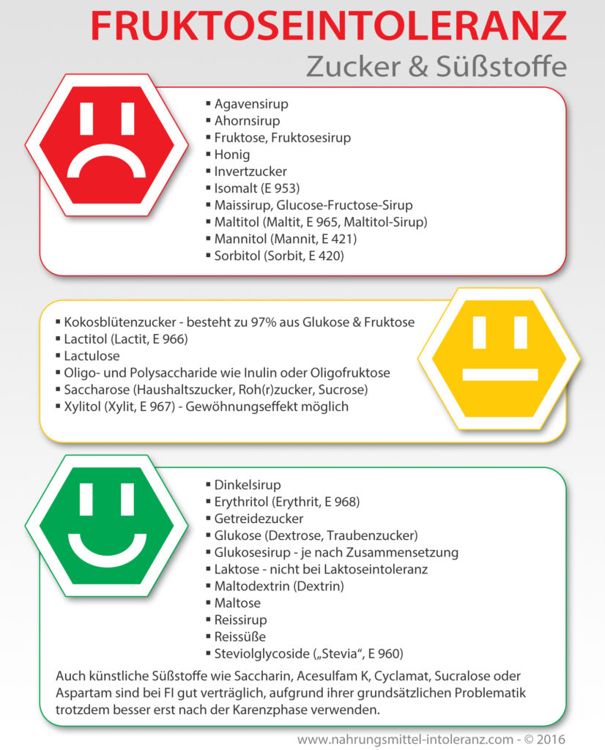
Well tolerated (even during the elimination diet):
- Spelt syrup – made from glucose and maltose
- Erythritol (erythritol, E 968) – moderate, rather at the end of the elimination phase
- Cereal sugar – mainly from glucose, good baking properties as bound water is reduced
- Glucose (dextrose, grape sugar) – often makes doughs sticky (due to approx. 10% bound water)
- Glucose syrup – depending on composition (see above)
- Lactose – not for lactose intolerance
- Maltodextrin (dextrin)
- Maltose
- Rice syrup – made from glucose and maltose
- Rice sweetener – dried rice syrup
- Steviol glycosides (“Stevia”, E 960)
- artificial sweeteners such as saccharin, aspartame, cyclamate, sucralose or acesulfame K – due to their fundamental problematic nature, it is still better to use them only after the elimination phase
- Monk fruit concentrate
Individually compatible after elimination diet
- Coconut blossom sugar – consists of 97% glucose & fructose, so is equivalent to normal sucrose
- Lactitol (Lactitol, E 966)
- Lactulose
- Oligo- and polysaccharides such as inulin or oligofructose, fructans, oligosaccharides – although the word “fructose” is in there! These sugar chains are not broken down into fructose in the intestine. For a detailed explanation see above.
- Sucrose (table sugar, raw sugar, sucrose) – should be part of your permanent diet, do not avoid it strictly!
- Glucose-fructose syrup (see above)
- Xylitol (xylitol, E 967, “birch sugar”) – habituation effect possible
Xylitol is extremely toxic for pets (dogs, ferrets, rabbits, …) and can lead to death even in small quantities!
Not compatible
- Agave syrup
- Maple syrup – Maple syrup can also contain tolerable sugars, the composition of this natural product is not regulated – therefore better avoid it.
- Fructose, fructose syrup
- Honey – no matter from which blossoms!
- Invert sugar (syrup)
- Isomalt (E 953)
- Corn syrup, fructose-glucose syrup / glucose-fructose syrup
- Maltitol (maltitol, E 965, maltitol syrup)
- Mannitol (mannitol, E 421)
- Sorbitol (sorbitol, E 420)
Sorbate is not the same as sorbitol! Sorbate is a salt and is often used as a preservative. It is usually used as potassium sorbate or calcium sorbate (E202 and E203). Sorbate is classified in the literature as harmless in the case of intolerances.
Rumor mill and FAQ
Sugar can simply be replaced by glucose.
No. You shouldn’t, it’s unhealthy for many reasons. On the one hand, glucose increases the release of insulin, on the other hand, too much glucose can lead to bacterial imbalance or support this . This applies to caries as well as small intestinal colonization. So always use dextrose sparingly.
Sugar must always be avoided with FI.
No, this only applies to the elimination diet. He should then be reintroduced to the diet at . Otherwise the situation usually deteriorates dramatically.
Cereal sugar is better than glucose
No. Grain sugar is glucose without bound water. I.e. Grain sugar is physiologically the same as glucose. It is only more suitable for baking because of the lack of water.
Rice syrup is better than glucose
Partly yes. It also contains a lot of glucose (and maltose) and should therefore also be used with moderation and purpose.
Coconut blossom sugar is okay for fructose intolerance
No. This is not true or only partly true!
Coconut blossom sugar
(palm sugar, palm honey, coconut sugar) consists of 97% glucose and
fructose, so it is the same as normal sucrose (sugar) and is also
nutritionally and with regard to fructose intolerance.
Rumor: Sorbitol, xylitol … in toothpaste and mouthwash should be avoided!
No. That’s not true! These substances cause problems as soon as they reach the intestine. And if you don’t intend to eat your toothpaste, you don’t need to worry ! On the contrary, due to the caries-inhibiting effect of xylitol , such pastes are actually highly recommended! The only problem is when it comes to people who swallow large quantities of toothpaste (e.g. children).
Sorbitol becomes fructose
No, or well… The enzyme sorbitol dehydrogenase converts sorbitol, which is made from glucose, into fructose in the body . This is a very important process in the body that has nothing to do with fructose malabsorption ! We often read that sorbitol should be avoided because it is converted to fructose in the intestine (or in the body). That’s not true! Sorbitol is produced in the body (e.g. the liver) as an intermediate stage to convert glucose into fructose. So yes: sorbitol turns into fructose in the body; but no: not in the intestine, but in the body.
Although this statement is true, it has nothing to do with fructose intolerance.
Sorbitol must be strictly avoided
No, you don’t have to give up sorbitol completely, but you should always consider what you have eaten during the day (the more fructose, the worse) and how much you personally can tolerate. Sweets and chewing gum with sorbitol usually have too much sorbitol, but small amounts in some types of fruit or vegetables are often harmless and are well tolerated after the elimination phase. Sorbitol can therefore be tested after the elimination diet and should not be completely removed from the diet .
Sources include:
- Römpp, H; Falbe, J; Regitz, M; “Römpp Lexikon Chemie”, 9th edition, Thieme Verlag, 1992.
- Opinion of the Scientific Committee on Food on Erythritol; EUROPEAN COMMISSION HEALTH & CONSUMER PROTECTION DIRECTORATE-GENERAL;SCF/CS/ADD/EDUL/215 Final; March 24, 2003;
- Dunayer, E. K. (2004). Hypoglycemia following canine ingestion of xylitol-containing gum. Veterinary and Human Toxicology, 46(2), 87-8. Retrieved from http://www.ncbi.nlm.nih.gov/pubmed/15080212
- Roberts, A., Renwick, A. G., Sims, J., & Snodin, D. J. (2000). Sucralose metabolism and pharmacokinetics in man. Food and Chemical Toxicology, 38(SUPPL. 2), 31-41. doi:10.1016/S0278-6915(00)00026-0
- Rumessen, J. J., & Gudmand-Høyer, E. (1988). Functional bowel disease: malabsorption and abdominal distress after ingestion of fructose, sorbitol, and fructose-sorbitol mixtures. Gastroenterology, 95(3), 694-700.
- Schuttert, J. B., Fiedler, G. M., Grupp, C., Blaschke, S., & Grunewald, R. W. (2002). Sorbitol transport in rat renal inner medullary interstitial cells. Kidney International, 61(4), 1407-1415. doi:10.1046/j.1523-1755.2002.00285.x
- Ordinance on types of sugar of October 23, 2003 (BGBl. I p. 2098), as amended by Article 7 of the Ordinance of February 22, 2006 (BGBl. I p. 444)